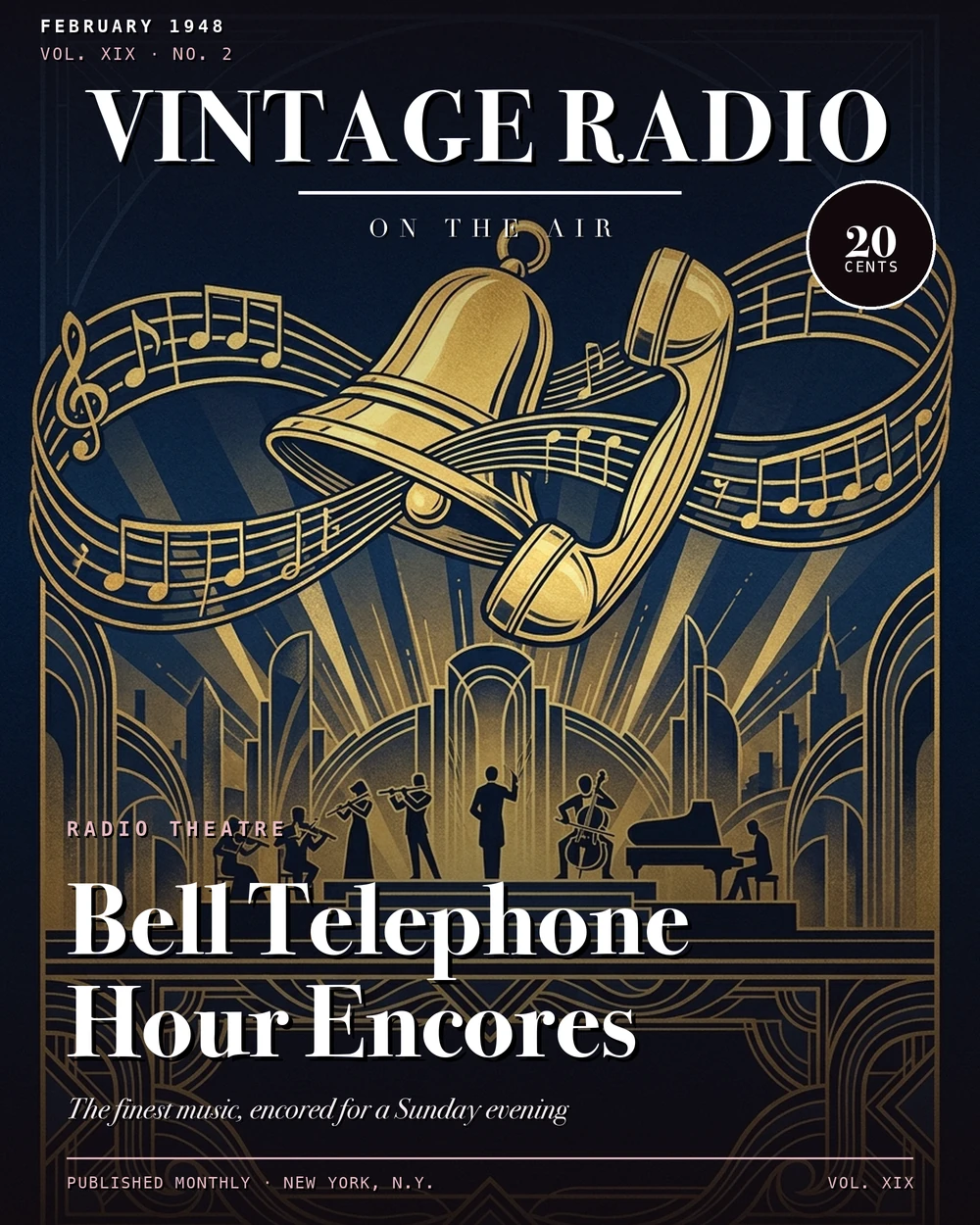
Bell Telephone Hour Encores
A Second Listen to Eighteen Years of Music
The Encores from the Bell Telephone Hour had an unusual job: it asked listeners to revisit a show that had already run for eighteen seasons and ended a decade earlier. Starting September 15, 1968, NBC aired these Sunday programs through June 8, 1969, with Donald Voorhees hosting and narrating highlights drawn from the original Bell Telephone Hour broadcasts. The format combined performance recordings with interviews featuring the stars who had appeared on the original series. It was, in effect, a curated retrospective of one of radio's longest-running classical music programs, put back on the air while many of the artists who made it were still working.
The Encores drew on a deep well. The original Bell Telephone Hour had premiered on NBC on April 29, 1940, and ran until June 30, 1958, completing 935 broadcasts across eighteen seasons. Bell Telephone — technically American Telephone and Telegraph — sponsored the show throughout. Monday nights at 8 became Monday nights at 9, but the half-hour format and the NBC home never changed. For most of those years, the program reached an estimated eight to nine million listeners every week, a number that reportedly held steady from the beginning of the run to the end.
The Original Show and How It Was Built
The Bell Telephone Hour launched as a showcase for light classical music. Tenor James Melton and soprano Francia White were the featured soloists in those first two years, supported by a 57-piece symphony orchestra drawn largely from musicians in the New York Philharmonic. Donald Voorhees conducted from the start and wrote the show's signature theme, the Bell Waltz, for that first broadcast. Ken Christie directed the chorus. Tom Shirley announced in the early years, later succeeded by Gayne Whitman and Dick Joy; Warner Anderson also served as announcer at various points, with Floyd Mack handling commentary and narration duties.
The publication Tune In described the program's range as "a musical melting pot, blending the old world with the new, from Bach to Irving Berlin, from Swanee River to Santa Lucia, from Latin American folksongs to the latest in Russian opera." That breadth was intentional. Producer-director Wallace Magill, who arrived and eventually replaced the original Melton-and-White format, shifted the show toward what he called the Great Artists Series — a rotation of leading vocal and instrumental performers from opera and the concert stage. Magill also selected the music and worked programs out roughly two months before broadcast, while guest bookings were often made as much as a year in advance.
The engineering behind the broadcasts was precise. AT&T engineers at NBC's Studio 6A and the Cathedral Studio at 711 Fifth Avenue designed specific microphone placements: a directional microphone eight feet in front of the strings, and another suspended ten to fifteen feet above and twenty-five feet ahead, to maintain clarity and balance across the orchestra. In the mid-1950s, the broadcasts moved to Carnegie Hall.
The Artists Who Appeared
Jascha Heifetz inaugurated the Great Artists Series on April 27, 1942, and by 1949 had made 37 return appearances on the program. His interpretation of Dinicu's Hora Staccato became the show's most requested number. Fritz Kreisler, who had long resisted radio, eventually ended that holdout by appearing on the Bell Telephone Hour — and came back 18 times over eight years. The roster across the full run included Marian Anderson, Helen Traubel, Lily Pons, Grace Moore, John Charles Thomas, Oscar Levant, Nelson Eddy, pianist José Iturbi, Maggie Teyte, Blanche Thebom, Gladys Swarthout, Bidu Sayão, Jennie Tourel, Jussi Björling, and Gregor Piatigorsky, among many others. For many of these performers, the show was how general American audiences first came to know them.
The program wasn't exclusively classical. Popular fare appeared a few times each year — Bing Crosby and Benny Goodman both performed, and Ezio Pinza and Mary Martin brought South Pacific melodies to the airwaves. On December 14, 1953, Fred Allen read the narration for Prokofiev's Peter and the Wolf while Voorhees conducted; an earlier version of the same program had featured Basil Rathbone. Beginning in 1946, the show also set aside an annual slot for winners of the Walter W. Naumburg Musical Foundation awards, spotlighting young and little-known talent alongside the established names. Pianist Lorin Hollander, a child prodigy, made his Telephone Hour debut in 1956 at age twelve, and later recalled of the series: "It was a way in which all of America could share an enriching experience."
Despite its title, the Bell Telephone Hour almost never actually ran for an hour. Only two of the 935 broadcasts were full sixty-minute programs; the first of those was in 1947, marking the 100th anniversary of Alexander Graham Bell's birth. The final radio broadcast, on June 30, 1958, featured guest Theodor Uppman, who closed the program with Massenet's "Le Cid."
Donald Voorhees, Who Tied It All Together
Voorhees was the constant throughout the original run and the organizing presence in the Encores series. Born in Allentown, Pennsylvania, on July 26, 1903, he joined the Lyric Theatre orchestra there as a pianist at twelve, became its conductor at fifteen, and made his Broadway debut at seventeen conducting the revue Broadway Brevities of 1920. He had been active as a radio conductor since 1925, formed the Voorhees Orchestra in 1926, and served as musical director on Cavalcade of America from 1935 to 1941 before taking the Bell Telephone Hour post when the show premiered in 1940. He held that role for the entire eighteen-year radio run, composed the Bell Waltz that opened every broadcast, and then carried his role into the television series that followed.
His connection to Allentown ran straight through his career: he founded the Allentown Symphony Orchestra in 1951 and served as its conductor and musical director until he retired on November 20, 1983. He was nominated for an Emmy in 1966 for individual achievement in music for his television work on the Bell Telephone Hour, and he died on January 10, 1989, in Cape May Court House, New Jersey. When the Encores series brought the original broadcasts back to radio in 1968, Voorhees was the natural host — he had conducted virtually every program being revisited.
The Television Years the Encores Drew From
The Bell Telephone Hour moved to NBC television on January 12, 1959, and ran there until 1968, giving the Encores series an even larger body of material to draw on than the radio broadcasts alone. The television series was among the first to broadcast exclusively in color, using the RCA color system adopted in 1954. It aired Friday evenings at 10, shifting to Tuesdays at 10 in 1963, and at various points alternated weeks with Sing Along with Mitch and The Andy Williams Show.
The television guest list overlapped with the radio years in some cases and expanded considerably in others. Isaac Stern, Yehudi Menuhin, Julie Andrews, Ella Fitzgerald, Duke Ellington, Harry Belafonte, Leontyne Price, Joan Sutherland, and Rudolf Nureyev all appeared. Nureyev's 1962 and 1963 appearances represented some of his earliest exposure on American television. Ballet dancers Edward Villella and Jacques d'Amboise were recurring presences, with Villella in roughly twelve episodes and d'Amboise in about eleven. John Raitt appeared eleven times across the run; Carol Lawrence about ten; the Buster Davis Singers served as a regular choral ensemble, and announcer Mel Brandt appeared in approximately 45 episodes across the television series' nine years.
A notable 1960 episode staged a full production of Gilbert and Sullivan's The Mikado with Groucho Marx as Ko-Ko alongside Helen Traubel and Robert Rounseville. The series' debut television episode, subtitled "Adventures in Music," featured Harry Belafonte, Maurice Evans, Renata Tebaldi, George Balanchine's New York City Ballet, duo-pianists Arthur Gold and Robert Fizdale, and the Baird Marionettes — a scope that set the tone for the television run. One of the final videotaped episodes, "First Ladies of Opera," gathered Joan Sutherland, Leontyne Price, Renata Tebaldi, and Birgit Nilsson on a single program. During the last television season, 1967–68, the format shifted from studio videotape to filmed location documentaries, including a tour of the Museo del Prado in Madrid featuring Andrés Segovia, Alicia de Larrocha, and Victoria de los Ángeles.
The program received a Peabody Award for radio entertainment in music in 1944, and a second Peabody for television entertainment upon its television debut. A third Peabody Special Award followed, with judges noting that the Bell Company "has the rare good sense to key its commercials into the mood of the program itself." New York Times critic Jack Gould, reviewing the television premiere, wrote that the series, "for so many years one of the more civilized fixtures of radio (has) re-emerged... a varied delight with impeccable taste."
What the Encores Series Preserved
The Encores programs also aired on the Armed Forces Radio Service under the titles Music from America and Heritage Radio Theater, extending the audience beyond NBC's domestic Sunday broadcast. Performers featured in the surviving Encores episodes include Ezio Pinza, Eileen Farrell, Zino Francescatti, Helen Traubel, José Iturbi, Ferruccio Tagliavini, Grace Moore, Robert Casadesus, John Charles Thomas, Lily Pons, and Bidu Sayão, drawn from the original broadcasts. At least 31 episodes of the Encores run are known to survive.
The broader archive across both the radio and television phases has been maintained in several institutional collections. The NYPL Rodgers and Hammerstein Archives of Recorded Sound holds live audio from the weekly radio programs, television audio, rehearsal recordings, performer interviews, and commercials. The University of Maryland's Michelle Smith Performing Arts Library also holds archival material from the Encores series specifically, as part of the Robert Sherman collection. The Bell Telephone Hour Orchestra's roster itself turned out to include figures of lasting musical significance: clarinetist and saxophonist Joe Allard, who played in the orchestra, later became a celebrated teacher at the Juilliard School and the New England Conservatory, with students including John Coltrane, Stan Getz, Eric Dolphy, and Mike Brecker. In 1947, a 27-minute theatrical short titled Rehearsal: The Telephone Hour was released to movie theaters, showing Voorhees and the orchestra alongside Ezio Pinza and Blanche Thebom in a simulated rehearsal and broadcast, originating from NBC's Studio 6B at 30 Rockefeller Plaza.
The Encores series ran for less than a year, closing on June 8, 1969. It was a summary of something much larger — a music program that had run continuously across radio and then television for nearly three decades, shaped throughout by one conductor, one sponsor, and a consistent conviction that the full range of classical and operatic performance belonged on American commercial radio.